The Science
From a single gene to the energy in every cell.
You don't need a background in molecular biology to follow what we're working toward. Here is the science behind COX20 deficiency — and the gene therapy being explored — explained simply and honestly.
How our cells make energy
Our bodies are made up of trillions of cells, and every cell needs energy to function. Different types of cells have different jobs, including the cells that make up the brain and nervous system.
Inside almost every cell are specialized structures called organelles. One of the most important is the mitochondrion (plural: mitochondria).
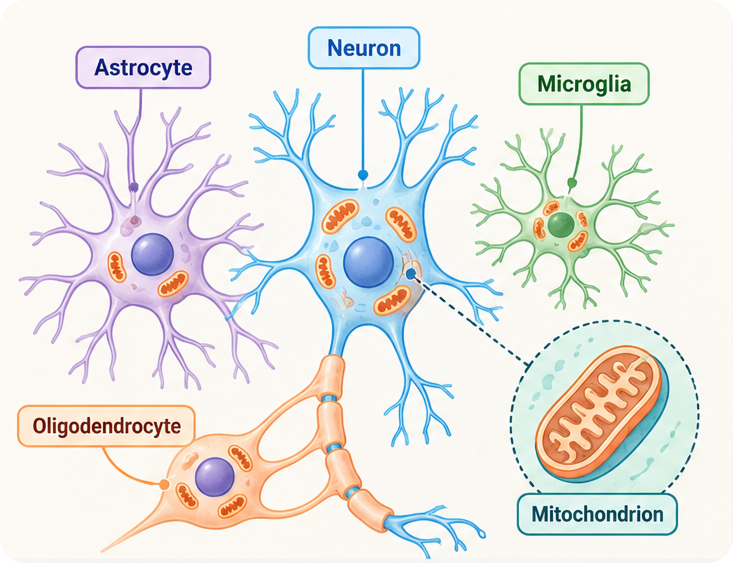
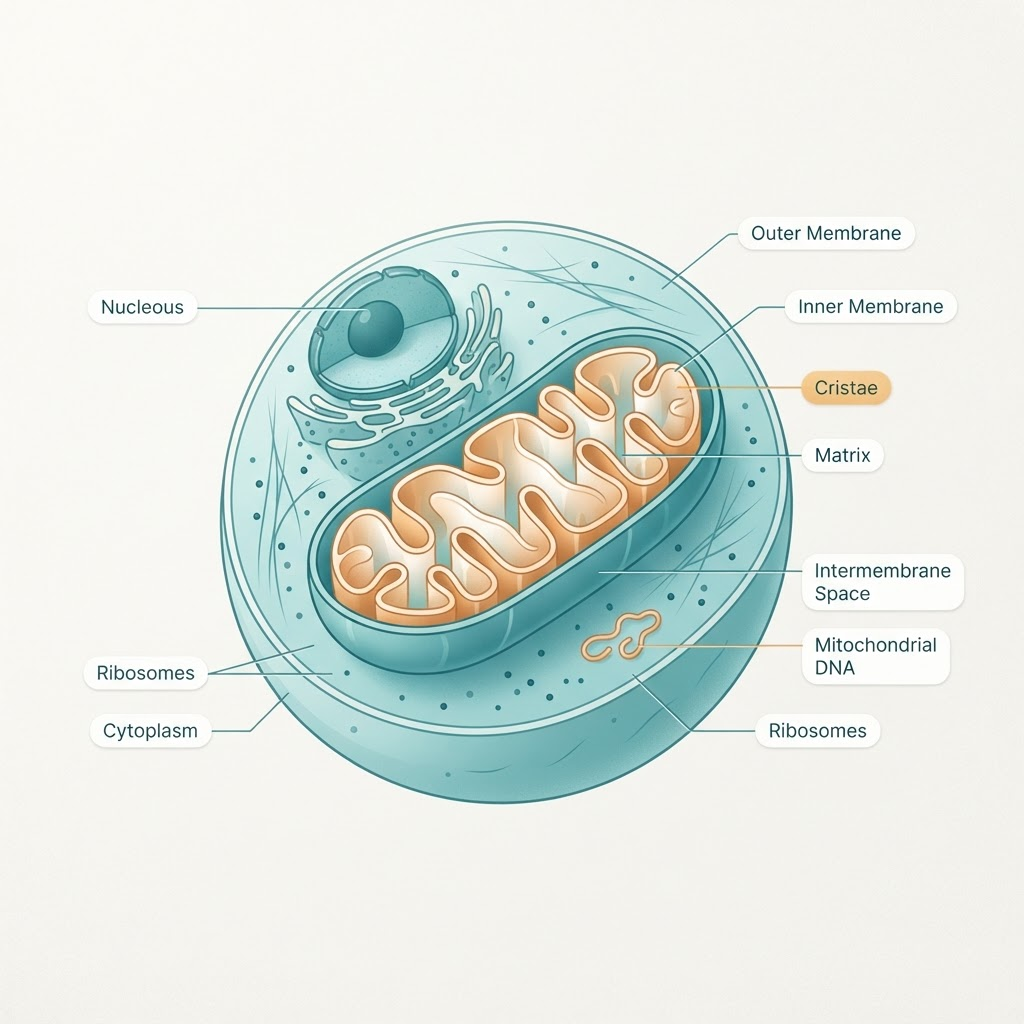
Mitochondria: the cell's power plants
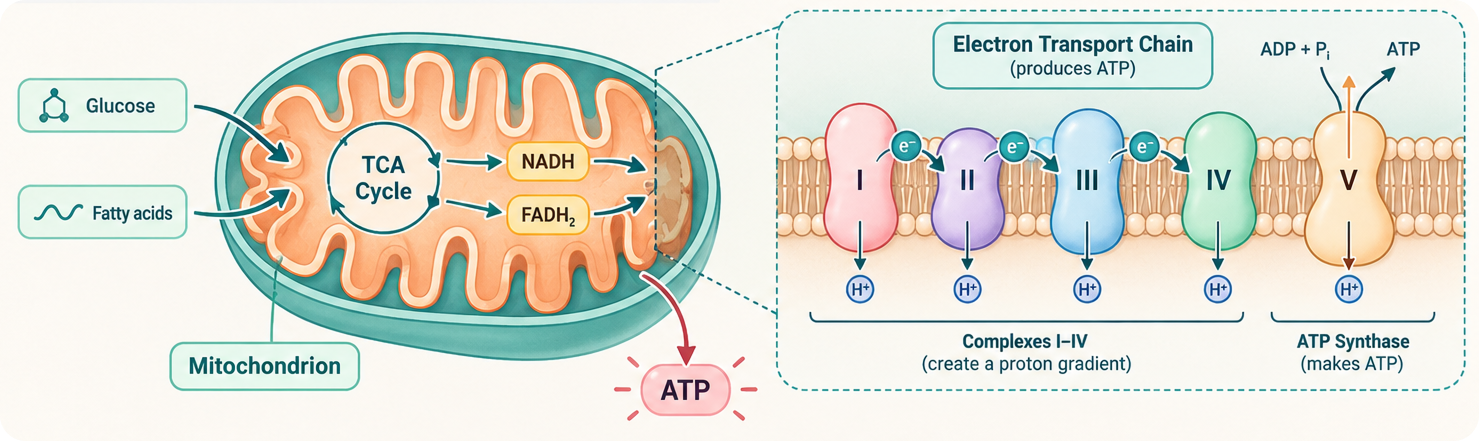
Mitochondria convert energy from the food we eat into a form that cells can use. This usable energy is called ATP.
To make ATP, mitochondria use a highly organized process called oxidative phosphorylation, or OXPHOS. It depends on five major protein complexes located in the inner membrane of the mitochondria.
Think of them as a carefully coordinated energy-producing system. Each complex has a specific job, and they work together to convert energy from food into ATP.
The role of Complex IV
Complex IV has a particularly important role in this process. As electrons move through the respiratory chain, energy is used to create a difference in the concentration of protons across the inner mitochondrial membrane — a stored energy gradient. Complex V uses that gradient to produce ATP.
Complex IV is also the final complex in the respiratory chain and uses oxygen as part of this process. Because of its important position in the energy-producing system, problems with Complex IV can significantly impair the mitochondria's ability to produce energy.
Where COX20 comes in
Complex IV is made up of many different parts that have to be assembled correctly. Three of its core components are called COX1, COX2, and COX3.
This is where COX20 plays an important role. COX20 acts as an assembly factor and chaperone for COX2, helping stabilize COX2 as it is being made and supporting its proper maturation and incorporation into Complex IV. COX20 also works with other proteins involved in COX2 maturation.
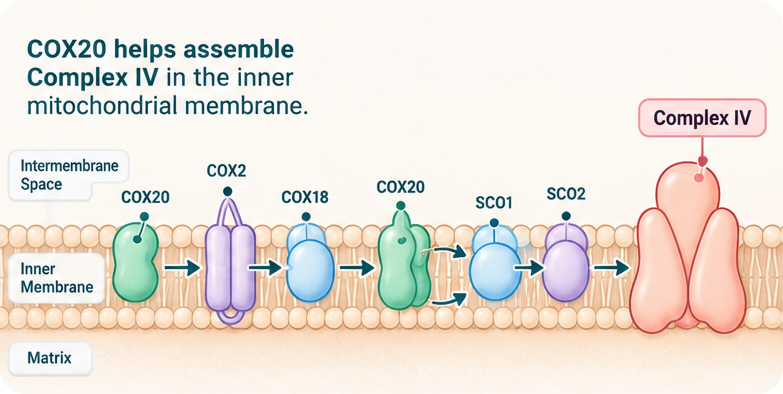
Think of COX20 as making sure one important piece of the Complex IV “machine” is prepared correctly before it is incorporated into the finished complex.
What happens when COX20 doesn't work?
When disease-causing changes in the COX20 gene prevent COX20 from functioning properly, COX2 becomes unstable and is not efficiently incorporated into the developing Complex IV. The cell's quality-control systems can recognize the problem, and COX2 can be broken down rather than becoming part of a functional complex.
Without enough properly assembled COX2, Complex IV cannot be fully assembled and its activity is reduced. Studies of cells from people with COX20 variants have demonstrated impaired Complex IV assembly and function. This is known as mitochondrial Complex IV deficiency.
When Complex IV is deficient, the mitochondria cannot produce energy as efficiently through oxidative phosphorylation. Cells that depend heavily on mitochondrial energy production can be particularly vulnerable to this problem.
COX20 deficiency
COX20 deficiency is an ultra-rare mitochondrial disorder. The symptoms reported in affected individuals most often involve the central and peripheral nervous systems, although symptoms can vary from person to person.
Reported features can include
- Ataxia
- Difficulty coordinating movement and balance
- Hypotonia
- Reduced muscle tone
- Weakness
- Reduced muscle strength
- Sensory neuropathy
- Problems with nerves outside the brain and spinal cord
- Dysarthria
- Difficulty with speech and articulation
Other neurological symptoms can occur, including dystonia and ophthalmoplegia in some individuals. The severity and combination of symptoms can differ between individuals.
Why gene therapy is being explored
Today, there is no treatment that can correct the underlying genetic cause of COX20 deficiency. But we know which gene is involved — and that creates a potential opportunity for gene therapy.
The basic idea is to deliver genetic instructions that allow cells to produce a functional COX20 protein. If the therapy can deliver enough functional COX20 to the appropriate cells, the goal is to restore COX20's role in COX2 maturation and support the proper assembly and function of Complex IV.
This approach is intended to address the underlying genetic deficiency rather than simply treating individual symptoms.
How gene therapy works
A gene therapy generally requires two key components.
A delivery vehicle
The genetic instructions need a way to reach the cells where they are needed. One promising delivery system is recombinant adeno-associated virus (rAAV) — a modified form of a virus that does not cause disease in humans and can carry genetic material into cells.
AAV-based gene therapies have been approved by the U.S. FDA for several genetic diseases. The AAV capsid acts like a protective container carrying the information cells need to produce COX20.
The genetic instructions
Inside the AAV vehicle is the genetic information designed to allow cells to produce COX20.
Researchers can study and optimize both parts of the therapy — the delivery vehicle and the instructions it carries — to determine how to deliver it as effectively and safely as possible.
The opportunity
COX20 deficiency is caused by changes in a specific gene, and researchers understand an important part of how those changes disrupt mitochondrial Complex IV. That gives researchers a clear biological target.
The goal of COX20 gene-therapy research is to provide cells with the genetic instructions needed to produce functional COX20 and, ultimately, to address the underlying mitochondrial defect.
There is still significant work to do before a potential therapy can be tested in patients. Researchers must determine whether the approach is effective, what dose may be appropriate, how it should be delivered, and whether it is sufficiently safe to advance.
The science gives us a place to start. Now the challenge is moving that science forward.
Fund the next step in the science.
Preclinical development is where promising research either advances or stalls. Your support helps it advance.